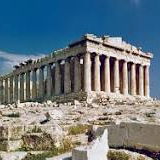
The Agora was the center of Athenian democracy, the site of the city's most important political events, and a place where both Pericles and Socrates walked. Visitors can explore the ruins of the ancient Agora, the remarkably well-preserved Temple of Hephaestus, and the reconstructed Stoa of Attalos, located at the foot of the Acropolis, in a site of outstanding natural beauty.
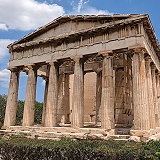
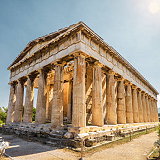
The Temple of Hephaestus, the god of blacksmithing, is a well-preserved Greek temple built in 449 BC by Iktinos as a dedication to Hephaestus; it still stands almost intact today. It is a Doric temple with surrounding porticoes, located northwest of the Athenian Agora, atop the Agoraios Kolonos hill.
Areopagus is a barren marble hill situated opposite the entrance to the Acropolis. Its ancient marble steps can be slippery, especially in the rain. Near the foot of the steps is a bronze stela inscribed with the Greek text of Paul's sermon. From the top of the hill, there are stunning views of the Acropolis.
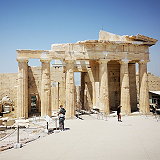
The Acropolis is an ancient citadel perched atop the city of Athens. Home to the iconic Parthenon, dedicated to the Greek goddess Athena, Erechtheion, and Propylaea, this archaeological site is the cornerstone of the ancient Greek civilization. The elevated site also offers breathtaking views of the city below.
The Parthenon is a former temple on the Athenian Acropolis, Greece, that was dedicated to the goddess Athena during the fifth century BC. Its decorative sculptures are considered some of the high points of Greek art, an enduring symbol of Ancient Greece, democracy and Western civilization. The construction began in 447 BC when the Athenian Empire was at the height of its power.